

Most software today claims to have "AI features." Very few were actually built around them. There's a meaningful difference between a platform that bolts a chatbot onto an existing interface and one where AI is woven into the workflow itself, shaping how data moves from raw input to finished disclosure.
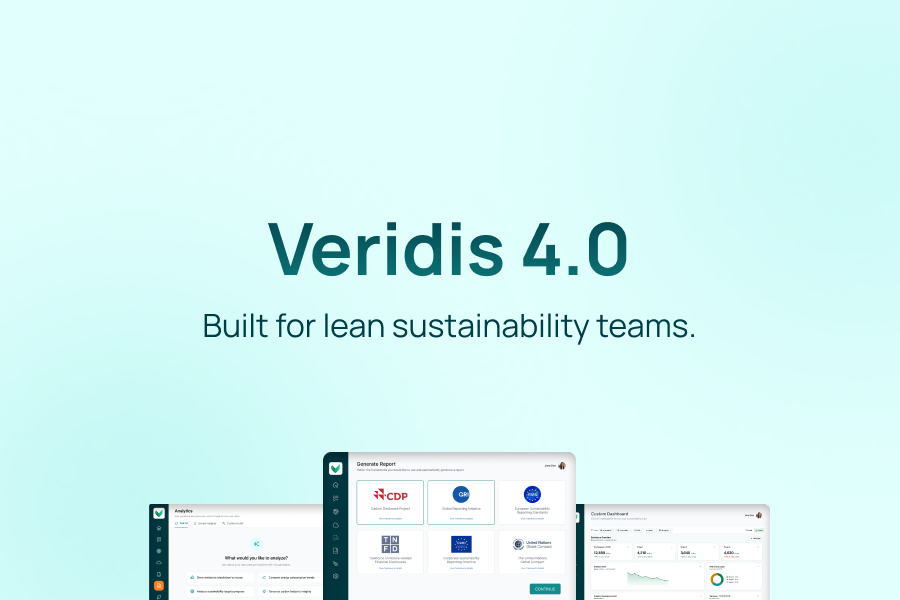
Veridis 4.0 belongs to the second category. Every stage of the sustainability data lifecycle, from the moment a document lands in the system to the moment a report goes out the door, has an AI layer designed to remove a specific piece of manual work. Not because AI is fashionable, but because the manual work it replaces has been one of the biggest drains on sustainability teams for years.
Why we built Veridis 4.0 AI-first
Ask any sustainability manager where their time goes, and data entry rarely comes up as the answer they're proud of. It's the answer they're stuck with.
A typical reporting cycle involves pulling numbers out of utility bills, supplier invoices, spreadsheets from different business units, and PDFs that were never designed to be machine-readable in the first place. Someone has to open each one, find the relevant figure, and type it into the system correctly. Multiply that across dozens or hundreds of data points, and it becomes clear why reporting periods are so often described as a scramble.
AI capabilities that simply didn't exist a few years ago, document scanning, pattern detection across large datasets, natural-language analysis, draft generation, have matured to the point where they can absorb that kind of work reliably. AI doesn't remove the need for the underlying data. It removes the need for a person to be the one extracting, formatting, and transcribing it by hand.
What AI-first looks like in practice
.jpg)
AI file ingestion. Veridis 4.0 can read a document the way a person would, but faster and without the fatigue that leads to transcription errors. Upload an invoice, a utility bill, or another source document, and optical character recognition combined with AI identifies the relevant figures and pulls them directly into your dataset. What used to be an afternoon of copying numbers into a spreadsheet becomes a review step instead of a data entry task.
.jpg)
AI-assisted data visualisation. Once data is in the system, the next challenge is usually making sense of it. Historically, that has meant exporting to a separate BI tool, or waiting on whoever on the team happens to know how to build a chart. In Veridis 4.0, the platform surfaces relevant visualisations on its own. Ask a question in plain language, and it identifies what kind of chart or breakdown actually answers it, without requiring anyone to configure an axis or write a query first.
.jpg)
AI-assisted data transformation. Collected data is rarely reporting-ready data. Raw inputs need to be converted into emissions figures, normalised across units, and mapped to the right categories before they mean anything on a disclosure. Veridis 4.0 handles much of that conversion automatically, including AI-assisted emission factor matching, so the right factor gets applied to the right activity data without someone manually cross-referencing a lookup table.
.jpg)
AI-assisted reporting. Rather than starting from a blank template and working through each disclosure requirement line by line, teams get an AI-drafted starting point built from the data they've already collected, aligned to whichever frameworks they're reporting against. The team still reviews, edits, and owns the final narrative. What changes is where they start from.
Built for teams who need AI to be dependable, not flashy
Sustainability data feeds into disclosures that regulators, auditors, and investors rely on. That means AI in this context has to be trustworthy first and impressive second. Every AI-assisted step in Veridis 4.0 keeps a human in the loop: extracted figures are reviewable before they're accepted, draft report content is editable before it's published, and anomaly detection flags unusual figures for a person to check rather than silently correcting them.
Looking further ahead, Veridis 4.0 has also been built to work well with agentic AI workflows, where an AI agent can carry out a multi-step task end to end rather than requiring a person to trigger each step individually. An upcoming MCP (Model Context Protocol) layer will extend that further, allowing Veridis to connect more deeply with the other tools already in a team's stack.
The goal isn't AI for its own sake. It's a platform that keeps absorbing the parts of the job that don't need a human doing them, so the people who understand the data can spend their time on the parts that do.
If you'd like to see how these AI capabilities work with your own data, book a demo with us today and we'll walk you through it.
FAQs
1. Do I still need to review data that AI has extracted or generated?
Yes. AI-extracted figures, generated visualisations, and drafted report content are all designed to be reviewed and edited by your team before they're finalised. AI accelerates the work; it doesn't remove human oversight from it.
2. What kinds of documents can AI file ingestion handle?
Invoices, utility bills, and other source documents containing relevant data points can be uploaded and processed using OCR combined with AI to extract the figures automatically.
3. I'm already an existing customer. Do I need to set anything up to start using these AI features?
No separate setup is required. These AI capabilities are part of the Veridis 4.0 upgrade, so they'll be available as part of your migration. Your account manager can walk you through what's included on your plan and when to expect access.
.jpg)


