Sustainability teams are small by necessity, not by choice. A handful of people are expected to pull data from every part of a large company, chase the numbers that never arrive on time, and still produce a report that holds up under scrutiny. The tools they use should make that easier. Too often, they don't.
Here's what that actually looks like day to day, and how Veridis 4.0 was built to change it.
Chasing data across a big, spread-out company
Pulling data together across departments, regions, and business units is never simple. No one is quite sure who owns what. The formats never match. And someone always ends up piecing it all together from a dozen spreadsheets sent a dozen different ways.
Veridis 4.0 fixes this at the source. Its data assignment features let teams give each piece of data a clear owner from day one. Instead of one person scrambling to compile everything at the end, the data arrives already organised, with accountability built in.
Hundreds of sources, endless follow-ups
Utility bills. ERP exports. HR records. Files from a dozen departments, each in a different format. A huge chunk of a sustainability team's time goes into simply asking people for information, then asking again when it doesn't show up.
Veridis 4.0 takes the chasing out of the equation. Data assignment workflows make every request visible and trackable, and the Integration module connects straight to the systems teams already use, so data flows in automatically instead of being hunted down one email at a time.
When you can't trust your own numbers
A figure looks off. Maybe it's double what it was last quarter, maybe it's suspiciously round. On a lean team, there's rarely time to stop and investigate, so the number either gets flagged with a shrug and a "we'll check it later," or it slides into the report as is because nobody has the bandwidth to chase it down.
That uncertainty is expensive in a way that's hard to see until it becomes a problem. Veridis 4.0 keeps a running history behind every figure as it's entered, not just at submission, so if something looks wrong, the context is already there instead of needing to be reconstructed. Small teams don't have a spare person to play detective. They shouldn't need one.
Needing a data analyst just to understand your own numbers
Collecting the data is only half the battle. Making sense of it usually means waiting on a data team, or wrestling with tools built for analysts rather than sustainability professionals.
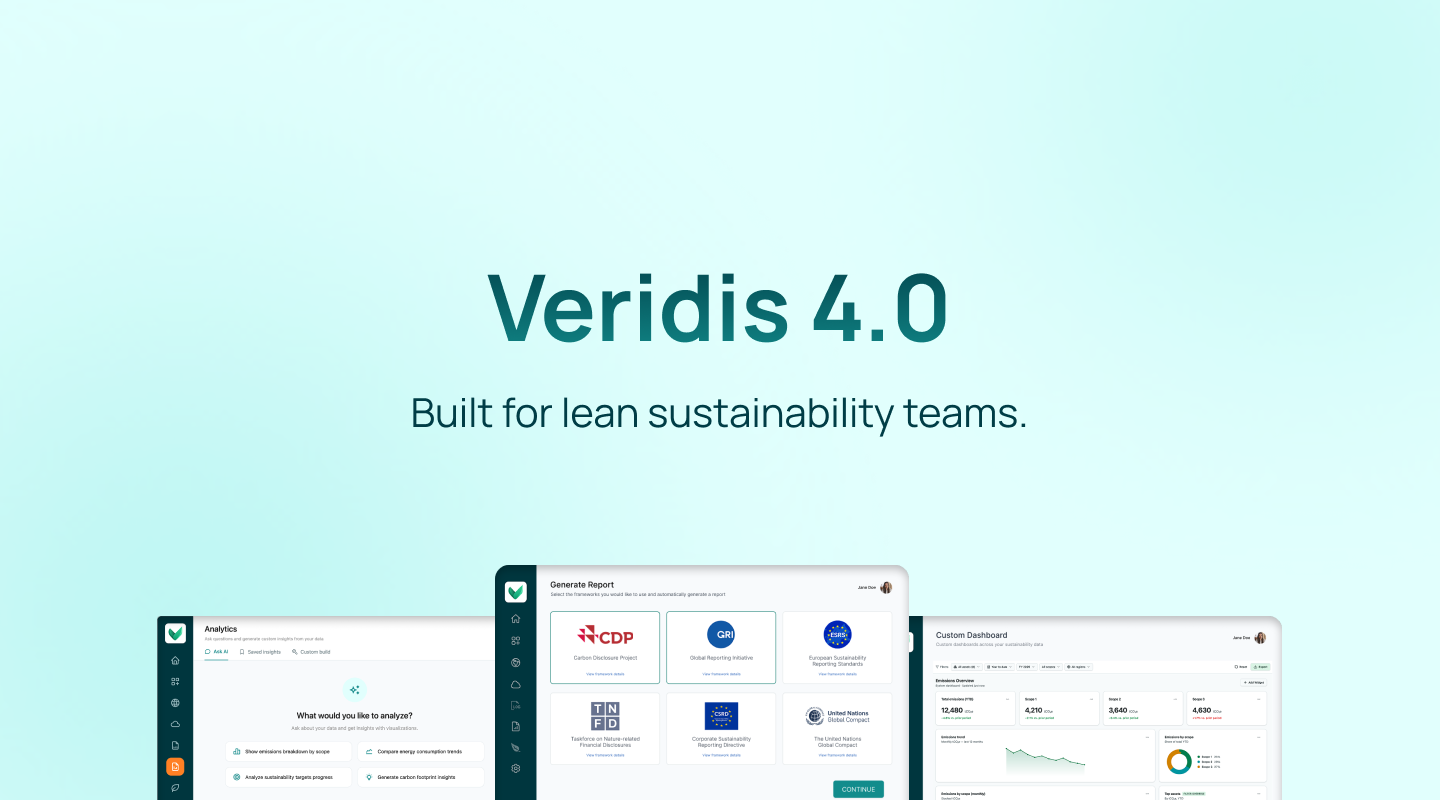
Veridis 4.0 removes that dependency. Ask a question in plain language and get an answer with the AI chat interface. Build a custom chart yourself. Or, if you know your way around SQL, take full control. However you like to work, the platform meets you there.
Drowning in manual work before the reporting even starts
Ask a sustainability manager what they actually spend their week on, and a lot of it isn't analysis or strategy. It's retyping numbers from a PDF invoice. It's opening a lookup table to find the right emission factor for a specific fuel type. It's staring at a blank report template, trying to figure out where to start.
None of that requires judgment. It requires time, and lean teams don't have much to spare. Veridis 4.0 takes each of these off the plate: source documents get read automatically instead of retyped, the right emission factor gets applied without a manual lookup, and reports start from a draft built out of your own data instead of an empty page. What's left for your team is the part of the job that actually needed a person in the first place: reviewing, deciding, and signing off.
The audit season scramble
Every year, audit season brings the same panic: pulling together emails, spreadsheet versions, and approval chains from memory, trying to reconstruct evidence that should have existed all along.
Veridis 4.0 skips the scramble entirely. Because every data point already carries a detailed history, the evidence auditors need is sitting there, ready, before audit season even begins.
Doing more with less, without burning out
Being lean doesn't have to mean being overstretched. Clear ownership cuts down the chasing. Automation cuts down the manual entry. Audit trails cut down the guesswork. Simple analytics tools cut out the need for a specialist. Put together, they give a small team back the one thing it never has enough of: time.
If you'd like to see what Veridis 4.0 can do for your team, book a demo with us today and we'll walk you through it.
FAQs
1. Is Veridis 4.0 built for small sustainability teams?
Veridis 4.0 is designed specifically for lean teams managing large, complex data volumes without a large staff to match. Its automation, data assignment, and self-serve analytics features exist to reduce the workload that would otherwise require additional headcount or specialist skills.
2. How does data ownership assignment actually work?
Teams assign specific data points or templates to individual owners from the outset, rather than one person compiling everything manually at the end. This creates built-in accountability and means data arrives already organised instead of needing to be pieced together across departments.
3. Do I still need a data analyst on the team to use Veridis 4.0's analytics?
No. Veridis 4.0 offers three ways to work with your data, an AI chat interface for plain-language questions, a visual chart builder, and a SQL mode for those who want it, so teams can get useful insight without relying on a dedicated analyst.